Hola! We’ve been building to this moment since we first walked into an overgrown, forgotten olive grove over a year ago.
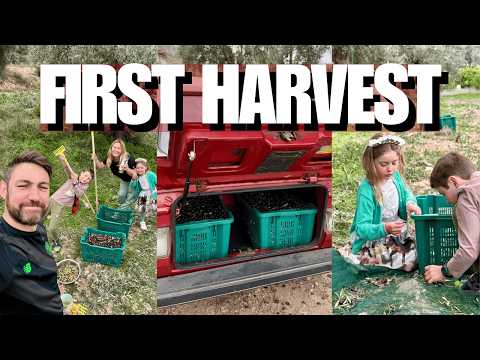
This week, we had our first olive harvest at Cortijo Renacer.
It wasn’t enormous. It wasn’t smooth. It involved rain, a red weather alert, a very small car packed with crates, and harvesting in the dark. But at the end of it all, we drove home with 12 litres of our very own olive oil — and it means everything.
🌿 Day One — Nets Down, Let’s Go
We laid the nets under the first tree, handed out the rakes, and got started as a family. What we were not prepared for was the sheer number of olives on just the very first branch.
One branch. One corner of one tree. The net filled up faster than we’d expected. Suddenly the scale of what the grove had produced this year hit us all at once.
As we harvested, we sorted at the same time — selecting the green and purple olives still in good condition to set aside as table olives for eating, and sweeping the darker ones into the crates for the press. The kids threw themselves into it, which was everything. One of them may have also accidentally raked the solar panels. In the excitement of the moment, we’ll allow it.
We harvested until the sun went down. Then kept going. By the end of day one we wanted every olive we could get before the weather changed.
⏱️ The 24-Hour Clock
By the following morning we’d harvested two and a half trees — and we had six crates of olives. But there’s a rule with olive harvesting: once picked, you have roughly 24 hours to get them to the press before the quality starts to deteriorate. After everything we’d put into this grove, we were not going to let that happen.
There was also the small matter of the weather. The sky had been doing its best threatening impression for days, and the forecast wasn’t kind.
First priority: get four crates to the press. Four was exactly as many as Gizmo could fit. Off we went.
🚗 Gizmo at the Olive Press
Gizmo — our small but reliable car, who had only recently recovered from his flat battery drama — looked beautifully, hilariously out of place pulling up to the local olive press among the tractors and farm vehicles. He didn’t seem bothered.
The olives went in. We waited. We’d brought roughly 4,000 olives in that first load (about 1,000 per crate), and watching them disappear into the press felt surreal after everything it took to get here.
We went home to wait for the processing — and to harvest the final two crates.
🌧️ Harvesting in the Rain
The rain arrived exactly when we’d hoped it wouldn’t.
We checked with the press: wet olives are still accepted, as long as they arrive within 24 hours of picking. The show went on.
In between storms, we got the last two crates done — six crates total. Back to the press. The queue was long, so we waited, then gave up and came back the next morning.
We probably should have queued — a red weather alert was issued overnight and safety had to come first. Sometimes Spain reminds you who’s in charge.
🔋 Winter Off-Grid, Honestly
The harvest days also gave us a real look at off-grid living in a Spanish winter. The solar panels struggled in the grey, rainy weather — not enough sun to charge the batteries properly. We had the generator running just to cover the base load, keeping the house going but not able to charge anything back up.
It’s a different challenge to summer. In summer, the sun is relentless and the system runs itself. In winter, you manage it carefully, you use what you have, and you’re grateful for every bright day.
🫒 12 Litres
A few days after the final delivery, we went back to collect our oil.
Six crates of olives. A year of work to bring that grove back from decades of neglect. Our first harvest as a family on this land.
12 litres of olive oil.
It’s not a commercial quantity. We know that. But that’s absolutely not the point. Every single bottle of that oil represents the trees we cleared by hand, the branches we pruned not knowing if we were doing it right, the mornings in the grove, the kids running between the trees, and the belief that this abandoned land could give something back.
It did.
And we have our first table olives curing on the side too — those ones we set aside on day one, still good enough to eat rather than press.
This is what land regeneration looks like. Slowly, imperfectly, wonderfully.
📺 Watch the Full Harvest
👉 Watch our first olive harvest on YouTube
📲 Follow Along
- 🌿 Instagram: @renacer_mcglynn
- 📘 Facebook: Follow us here
- 🛠️ YouTube: Renacer McGlynn Channel
¡Hasta la próxima! 🌻